Agentic AI's token bill is coming due. That's good news for owner-led businesses.
Macro strategists are repricing agentic AI around compute scarcity and token bills. The shake-out favors operators who run AI as governed workflows — not open-ended agents.
Wall Street just repriced agentic AI
In June 2026, Citadel Securities' macro strategy desk published a note titled "Tokenomics" arguing that agentic and complex AI workflows delivered by frontier models are expensive to run, constrained by physical bottlenecks, and vulnerable to unrealistic expectations of frictionless deployment cost. The note points to mounting reports of unexpectedly large token bills as evidence the market is waking up to the same thing.
Adoption is therefore becoming less about what frontier models can do in principle and more about the price and scarcity of the inputs required to make AI operational at scale.
The same note flags a decline in the Silicon Data LLM Expenditure Index — a benchmark of effective price per million tokens across the actively traded LLM market — and reads it as buyers substituting toward more efficient model choices. In plain terms: companies are discovering that frontier-model autonomy is billed by the token, and they are moving the bulk of their work somewhere cheaper.
None of this means AI adoption is stalling. It means the demo era is over and the unit-economics era has started. That transition rewards a very different kind of buyer.
Why agentic AI gets expensive
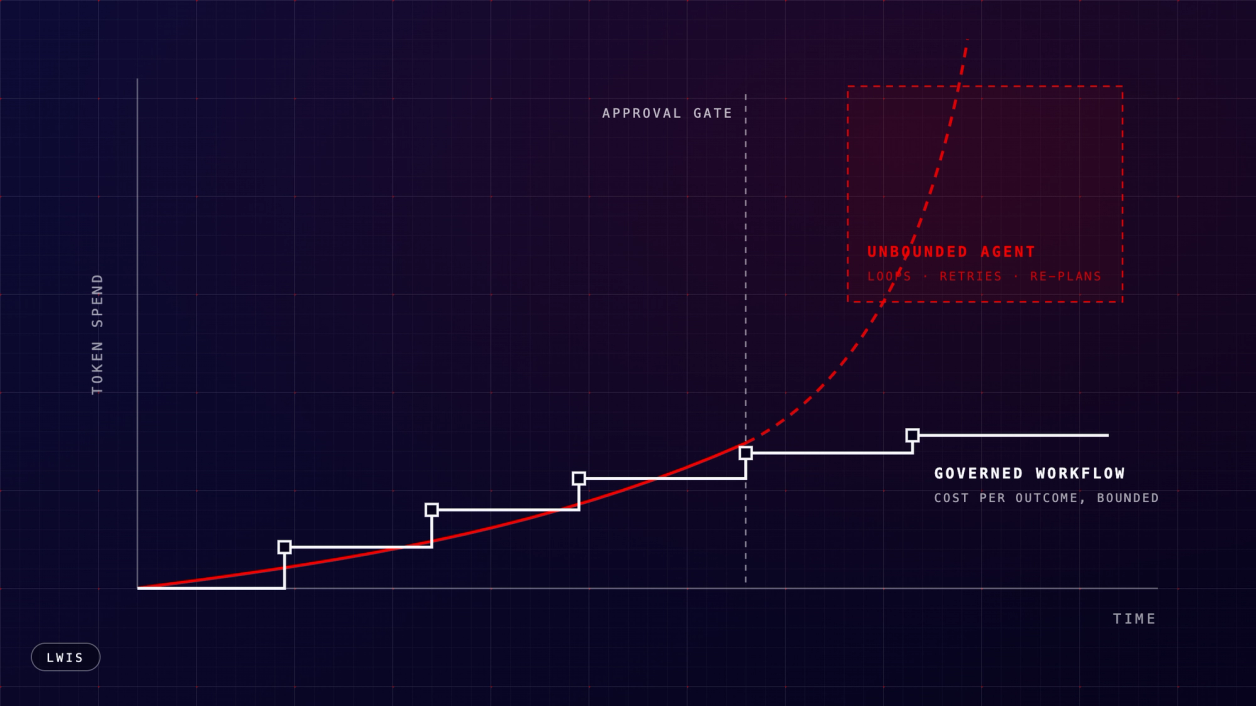
An open-ended agent is a loop: read context, decide, act, check, repeat. Every pass through that loop re-reads context and bills you for it. When the agent is uncertain, it re-plans. When a tool call fails, it retries. When the task is ambiguous, it explores. Each of those behaviors is reasonable in isolation — and each one multiplies token spend in ways no demo ever shows, because demos are short and production is not.
The second cost driver is the frontier-by-default habit. Most agent products route every step — including trivial ones like extracting a date from an email — through the most capable, most expensive model available, because that is the easiest thing to build. You end up paying reasoning-grade prices for clerical work.
Put those together and the cost profile of an unbounded agent is a distribution with a long, ugly tail. The median run is cheap. The bad runs — the loops, the retries, the fourteen re-plans — are where the surprise invoices come from. If nothing in the system bounds the loop, nothing bounds the bill.
If your last AI invoice surprised you, that's a symptom of an unbounded loop — not a cost of doing business.
Get a second opinion on your AI spend — it's a 20-minute conversationThe bifurcation favors owner-led businesses
The Citadel note predicts inference-intensive frontier AI will concentrate among firms with the balance sheets to absorb compute costs and operating domains hard enough to justify them — while "simpler models may be the more cost-effective, productivity-augmenting pathway" for the broader economy. We think that bifurcation is the single most useful framing an owner-operator can adopt right now.
Here is the part the macro desks don't say out loud: almost everything that eats an owner-led business's week sits on the everyday side of the split. Invoice intake, scheduling, review responses, payroll readiness, lead follow-up, document processing — high-volume, repeatable, bounded work. Today's everyday models handle that work well, at prices that keep falling, when the work is scoped tightly enough that the model isn't asked to improvise.
That last clause is the whole game. The businesses getting burned by token bills aren't using AI for harder problems than yours. They're using it with less structure — paying frontier prices for open-ended exploration of work that should have been a defined, bounded workflow.
Five questions to ask before you pay for "agents"
If you're evaluating any agentic AI product this year — ours included — these are the questions that separate a governed system from an open loop with your card on file:
- What does a completed workflow cost? Not per token, per seat, or per month — per outcome. If the vendor can't answer in those units, they don't know either, and the variance is yours to absorb.
- Which model runs which step, and who decided? Routing trivial steps to everyday models and reserving heavyweight reasoning for the steps that need it is the largest cost lever in the system. "We use the best model" means nobody is pulling it.
- What bounds the loop? A maximum step count, a budget per run, an approval gate before consequential actions — something has to stop a confused agent from spending all night being confused.
- What happens when it's wrong? Wrong answers that auto-execute cost more than the tokens that produced them. Look for a human approval queue and a real rollback story, not a confidence score.
- Where does the spend show up? AI cost should appear next to the work it did, in the same place you review the work — not as a line item you reverse-engineer from an invoice thirty days later.
Evaluating a vendor right now — including us?
Put these five questions to our team — bring your hardest workflowHow LWIS approaches tokenomics
LWIS was built on the unfashionable side of this argument before the macro desks arrived at it: AI work in an operating business should run as governed workflows, not open-ended agents. Every workflow in a pack has defined steps, and every step declares what it's allowed to do — which means every step can run on the cheapest model that clears its quality bar, and the expensive models only get pulled in where the work actually earns them.
Approval queues do double duty here. Operators think of them as a control surface — what runs on its own, what waits for a human. They are also a cost ceiling: a workflow that must stop for approval cannot loop unattended, so the long tail of runaway runs gets cut off by design rather than by hope. And because workflows are the unit of execution, cost lands where it belongs — visible per workflow, in the same daily brief where you review the work it paid for.
The specifics — how we route models inside a pack, what the gating evidence looks like before a workflow earns autonomy, where the budget thresholds sit — depend on the shape of your operation, and that's exactly what a Proof Sprint maps. If your token bill is already a line item you flinch at, or you want to adopt AI without ever getting there, that's a conversation worth having now, while the repricing is still in everyone's favor.
Frequently asked questions
Why are agentic AI costs rising?
Agentic workflows bill by the token, and open-ended agents multiply tokens through loops, retries, re-planning, and re-read context. Combined with frontier-model pricing and physical constraints on compute — power, cooling, memory bandwidth — production agent costs routinely land far above what short demos suggest.
Do small and mid-sized businesses need frontier models?
Mostly no. The operational work that consumes owner-led businesses — invoice intake, scheduling, review responses, payroll readiness, document processing — is high-volume, repeatable, and bounded. Everyday models handle it well at a fraction of frontier prices, provided the work runs as defined workflows rather than open-ended agent tasks.
How do you keep AI agent costs under control?
Bound the loop and route the models. Give every workflow defined steps, a budget per run, and approval gates before consequential actions; run each step on the cheapest model that clears its quality bar; and measure cost per completed workflow — not per token — so spend is visible next to the work it produced.
What is the difference between an AI agent and a governed workflow?
An agent decides its own next step in an open loop, which makes its cost and behavior hard to predict. A governed workflow has declared steps, declared permissions, and human approval gates — the same work gets done, but the loop is bounded, auditable, and priced per outcome.